
The Lisbon Early-Career Workshop in Urban Studies
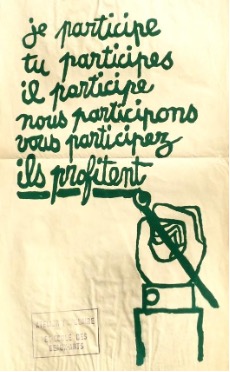
You participate, they profit: collective action, power and urban change
6th edition, November 4-6, 2026 @Instituto de Ciências Sociais da Universidade de Lisboa (ICS-ULisboa)
Organisation:
Keynote speakers:
- Laura Saija (University of Catania, Italy)
- Jonathan Davies (University of Birmingham, UK)
Call for proposal:
The focus of this year’s iteration of the workshop “you participate, they profit: collective action, power and urban change” takes its title from the famous poster produced by French art students during the uprisings of 1968. Its history speaks eloquently to long-standing debates about power, participation and urban political struggles.
By taking this image as a cue, the workshop aims to critically explore the forms of collective action and democratic participation found in cities, and how they might be challenged and rethought in response to the crises of the historical present. Key questions include: how do people come together in pursuit of common goals? Whatforms does collective action assume today in different latitudes? How does it relate to the changing physical, social, and economic fabric of urban space? What are its impact on urban governance and what is its contribution, if any, to more inclusive and just transformations?
The call understands collective action and democratic participation in tight connection with multiple forms of urban governance, here framed as deliberately broad, relational, and de-centered (Griggs, Norval & Wagenaar 2014). As such, the notion of governance here encompasses the institutional and logistical architecture of government, which manifests itself in the different sets of institutions (parliaments, governmental agencies, courts, etc.) and rules (laws and regulations, contracts, partnership agreements, etc.) which govern society. However, it also includes a broader universe of practices: the disparate catalogue of daily actions performed by masses of people, as expressed in the “the experiences, the interactions, the uncertain rules that regulate everyday life”, and “the efforts to build structures, to create a social order, to deal with authority, inequalities or incremental change, with the goal of keeping the city in line” (Le Galès & Vitale, 2015: 10). To paraphrase Abdoumaliq Simone (2004), these practices constitute a parallel set of infrastructures that contribute to the governance of our cities.
By ranging across this field of study and practice, the workshop seeks to examine the diverse sites, spaces and social forms through which urban politics are produced, managed, sustained and contested. In inviting proposals to the workshop, we are therefore interested in work that engages urban collective action and democratic engagement, whether understood as as ‘contentious’, ‘everyday’, or ‘participatory’ politics:
Contentious politics (McAdam, Tarrow & Tilly 2003) refers to “the ways organized citizens engage publicly with political change” (Mitlin 2018: 559) – through a wide range of practices that includes voting, lobbying, demonstrating, petitioning, etc. As such, it focuses on collective action as claim-making in which people advocate for political change vis-a-vis the status quo of governance – sometimes even questioning its political legitimacy. Owing to its centrality to the uneven development of capitalism, urbanisation has long occupied a central place in the study of contentious politics.
Everyday politics speaks to more routine, ordinary practices that are usually not included in a more conventional understanding of what constitutes “politics”, or “participation”. People constantly deploy ordinary practices to preserve individual and collective autonomy in the face of the society at large, and to appropriate the social and material resources that they need to go on with their daily lives (housing, economic opportunities, recreation, etc.). In doing so, they make implicit, sometimes illicit but often powerful claims to urban space and the resources required to create environments adapted to their own needs (Holston 2008), and in some accounts prefigure a range of alternative urban political possibilities.
Participatory politics speaks to democratic participation in its multiple forms, traversing a field of tensions between formal ‘invited spaces’ of state-sanctioned public involvement that are frequently criticised for coopting and depoliticising participation, and the ‘invented’ spaces through which participation emerges as a demand for power transformation. Set against a ‘real utopian’ horizon of empowered participatory governance (Fung & Wright, 2003), participation has the potential to pragmatically advance dreams of democratic living, infusing more inclusive and just visions to transform mainstream political practices. But how, and under what conditions might such radical democratic potential be realised?
As in all past editions, the workshop’s title is meant to inspire participants to creatively think about urban studies in general – and their work in particular. We thus invite contributions that engage with a broad range of urban phenomena and governance issues from diverse methodological, epistemological, theoretical and political perspectives.
Workshop activities include:
- Plenary keynote sessions.
- Breakout parallel sessions – divided in groups, participants will present their paper and receive comments by a mentor and other participants.
- Wrap-up session with discussion on lessons learned.
- Q&A session on “academic survival” (strategies and tips for academic publishing, and post-PhD challenges).
Who can attend the workshop:
The workshop is open to PhD students and early-career scholars in the fields of urban studies, planning and geography, and all the social sciences and humanities with an interest on space.
Some 30 participants will have the opportunity to present and discuss their research projects and/or findings during a 3-days event organised as a space of exchange, debate and learning.
A minimum of 8 seats will be reserved to members of the AESOP Young Academics, please mention in your motivation letter whether you are a member.
Application and registration:
Send an abstract for your presentation (max 500 words) and a short letter of motivation to roberto.falanga@ics.ulisboa.pt , Andy.Inch@glasgow.ac.uk and marco.allegra2010@gmail.com.
- Deadline for applications: April 15th, 2026.
- Decisions will be sent by April 30th, 2026.
- Registration by June 30th, 2026.
- Submission of long abstract or short paper (max 3,000 words, to be distributed among participants) by September 15th, 2026.
Registration fee: €200.
We will be able to offer a limited number of fee waivers and scholarships (€500). If you have no research funds and are interested in applying for a fee waiver or a bursary, please mention this in your motivation letter, briefly explaining the reasons why (priority will be given to scholars from low-income countries and/or from research institutions with little or no research funds).
Organising committee:
- Roberto Falanga (ICS-ULisboa)
- Marco Allegra (CES UCoimbra)
- Andy Inch (University of Glasgow)
Mentors:
- Laura Saija (University of Catania, Italy)
- Jonathan Davies (University of Birmingham, UK)
- Roberto Falanga (ICS-ULisboa)
- Marco Allegra (CES UCoimbra)
- Andy Inch (University of Glasgow)
- Fabio Bertoni (ICS-ULisboa)
- Simone Tulumello (ICS-ULisboa)
- Noel Manzano (Universidad Rey Juan Carlos)
Keynote speakers’ short bios:
Laura Saija associate professor in City and Regional Planning at the University of Catania, Italy and has been assistant professor the School of Urban Affairs and Public Policy, University of Memphis, TN, USA. Her research interests cross the boundaries of community development, planning and landscape design, and planning theory, and her work has focused on the role of universities in community development processes; on how action-research can be used to promote ecological development in the context of shrinking cities and regions. Laura is currently working on housing policy and on the need to reframe planning scholars’ understanding of the relationship between institutions and civil society, with a focus on the organizational dimension of the latter.
Jonathan Davies was Professor of Critical Policy Studies and founding Director of the Centre for Urban Research on Austerity at De Montfort University, Leicester (2011-2025). Since retiring, he has been associated to the Instiitute of Local Government Studies at the University of Birmingham. His research interests span critical issues in governance, urban studies and public policy. In addition to developments in governance theory, Jonathan works on austerity governance, urban resilience and social justice. He is currently working on implications of English devolution and the restructuring of local government.
References:
Fung A. & Wright E.O. (2003). Deepening democracy. Verso.
Griggs S., Norval A. & Wagenaar H. (2014). Introduction: Democracy, conflict and participation in decentered governance. In S. Griggs, A. Norval & H. Wagenaar (Eds.), Practices of Freedom: Decentred Governance, Conflict and Democratic ªarticipation (pp. 1-37). Cambridge: Cambridge University Press.
Holston J. (2008). Insurgent citizenship: Disjunctions of democracy and modernity in Brazil. Princeton University Press.
Le Galès P., & Vitale T. (2015). Diseguaglianze e discontinuità nel governo delle grandi metropoli. Un’agenda di ricerca. Territorio.
McAdam D., Tarrow S. & Tilly C. (2003). “Dynamics of contention.” Social Movement Studies 2, no. 1, 99-102.
Mitlin D. (2018). Beyond contention: urban social movements and their multiple approaches to secure transformation. Environment and Urbanization, 30, 557-574.
Simone A. (2004). People as infrastructure: intersecting fragments in Johannesburg. Public Culture, 16, 407-429.
 Urban Transitions Hub